
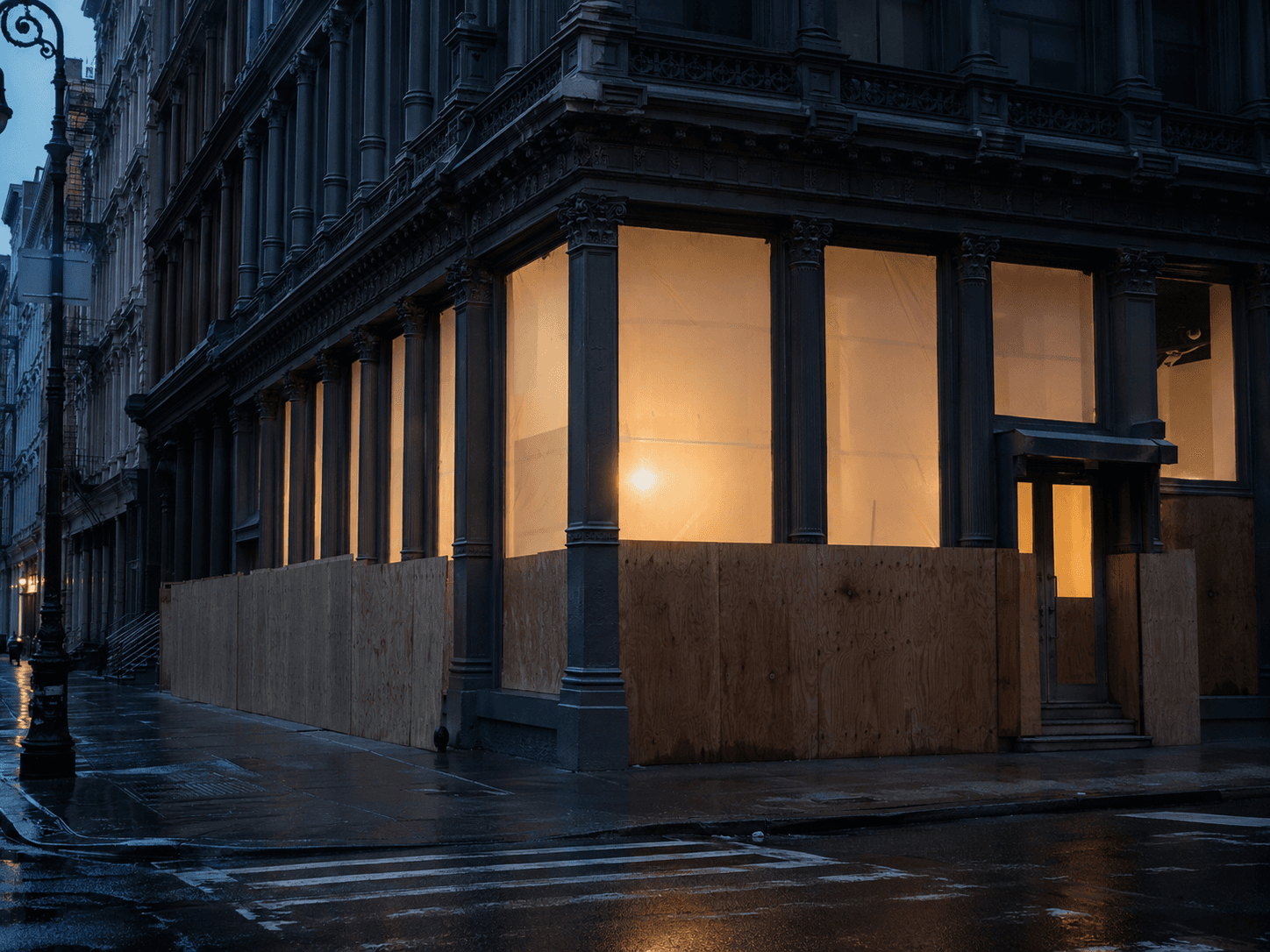
If you're a VP Marketing or Head of Retail looking at first-store concepts, these are the rooms you're probably standing in.
The buyer profile here is different from a traditional retailer. Decisions usually run through marketing or brand leadership before finance approves. The construction conversation has to fit into a brand-led approval process, not the other way around.
Apple
Touchpoint stores designed for product interaction, not stock-turn
Tesla
Showroom-led retail in mall and street locations, sales-light
Shopify Spaces
8,000 sf two-storey concept at 131 Greene Street, SoHo
Glossier
Experiential flagship model — high-density visual brand programming
Gymshark
9,400 sf SoHo location at 38 Greene Street, plus 4,000–13,000 sf US flagships
Allbirds
Hybrid retail — small footprints with full product range
DTC retail does not look like specialty retail.
The construction model has to flex around the lease and brand realities, not the other way around. If a GC is selling you the same playbook they use for specialty apparel, walk away.
- DTC leases tend to run three to five years rather than the ten-year horizon that anchors most specialty-retail rollouts, which changes both the rent economics and the willingness of the brand to invest in a permanent-grade finish program
- First-store opening windows are routinely compressed into the ninety-to-one-hundred-twenty days between lease signing and opening day, which means preconstruction, permitting and construction have to overlap in ways a conventional rollout does not require
- Experiential design intensity is materially higher than it is for specialty retail, with AV, programmable lighting, interactive fixtures and branded environments engineered for content capture often making up a significantly larger share of the construction budget
- Square footages are smaller — typically one thousand to four thousand for showrooms and touchpoints, and four thousand to ten thousand for first flagships — which inverts some of the cost ratios a specialty-retail GC will assume
- Pop-up programs frequently exist as the first stage of a planned pop-up-to-permanent path, where the brand tests a location for ninety days and converts to a five-year lease if the operating data justifies it, and that path needs to be planned at the start rather than improvised at the end
A scope written for the way DTC programs actually run.
- Build the program back from the target opening day rather than forward from the lease, which means we tell you on the first call which markets are realistically buildable inside your window and which ones are not
- Run pop-up programs of thirty to ninety days with permanent-grade finish standards, so that the brand experience inside the temporary location matches what the permanent version will eventually deliver
- Coordinate the experiential build elements — AV, programmable lighting, fixture interactivity, branded environments — through the construction process rather than as an afterthought
- Handle landlord and base-building coordination at second-generation TI sites, which is where the great majority of DTC first stores actually land
- Plan pop-up-to-permanent transitions from the start, so that if the pop-up performs we can move directly into the permanent buildout without restarting the design and permit conversation
First-store programs typically land between $300K and $1.2M.
Showroom and touchpoint programs at 1,500–3,000 SF in second-generation space sit in the $300K–$700K range. Experiential flagships at 4,000–10,000 SF in NYC, LA or similar markets push into the $1M–$1.5M range and occasionally beyond when the AV and millwork programs are heavy.
Per the EB3 Construction August 2025 benchmark, the national retail average is $214.35/SF. NYC sits at $294.43/SF; Razi Architects' LA range is $150–$450+/SF. Pop-ups vary wildly with finish level and lease term — we'll give you a defensible range inside the scoping call.